Daylio Journal - Mood Tracker
- 4.7
- Rating
- 10.00M
- Installs
- Free
- Price

 Analysis by App-foxy
I like journals that help me notice patterns without turning self-care into another demanding project, and Daylio Journal - Mood Tracker takes that approach seriously. It is a lifestyle app from Habitics that combines quick mood logging, private diary entries, habits, and goals in one place. My overall view is simple: it is most useful when you want a low-effort record of how your days feel, not when you want a long-form writing platform or a replacement for professional mental-health support.
The app’s biggest strength is the small amount of effort needed to keep using it. Instead of opening a blank page and wondering what to write, I can record a mood, choose activities, and add a short note when something needs context. That makes the habit feel manageable on busy days. The free download and Everyone age rating also make it easy to try, while optional in-app purchases range from $0.99 to $59.99 per item. I would still recommend checking the purchase choices carefully before committing to any paid extras.
How Daylio turns a quick check-in into a useful personal record
I find the most useful way to approach a quick check-in is to decide what I want to learn before I start tracking: energy, stress, sleep routines, or the effect of a particular habit. That keeps the record focused and makes later comparisons less muddled. From there, the important question is how Daylio turns those small entries into a personal record I can actually use.
You May Also Like

 Blood Strike: 2.5 Anniversary
Blood Strike’s Loadouts Turn Every Drop Into a Tactical Gamble
A close look at Blood Strike’s custom loadouts: how fast access to signature weapons reshapes its battle royale rhythm, rewards preparation, and narrows the gap between fights.

 Pandora - Music & Podcasts
Pandora’s Music Is Easy to Start, but Harder to Recover
Pandora’s strength is its low-effort path from a seed to a station. Its weak spot is how much confidence it asks you to place in connection, setup, and quiet recovery.

 8 Ball Pool
 Is Built on Rivalries, Rematches, and Routine
A close look at the rivalries, rematches, shared routines, and unanswered safety questions that turn a quick pool match into a persistent mobile community.

 Samsung Music
’s Quiet Strength Is Playing What You Already Own
Its reach comes less from spectacle than from dependable access to a personal library. That simplicity is both the app’s strongest retention engine and its ceiling.

 AccuWeather: Weather Radar
AccuWeather Review: A Quick, Clear Forecast for Everyday Decisions
For everyday plans, the best forecast is the one you can understand quickly. AccuWeather makes rain timing, radar, and local conditions easy to act on, with a few trade-offs.

 Hill Climb Racing
Why Hill Climb Racing Still Turns Crashes Into One More Run
A tiny car, a bumpy hill and one more upgrade: Hill Climb Racing keeps resurfacing because its simple chaos makes every near-miss feel personal.
More From Our News Desk
View All News


A journal built around momentum rather than long entries
The first thing I noticed is that Daylio Journal - Mood Tracker does not treat journaling as an all-or-nothing activity. A traditional diary often encourages a detailed entry, which can be rewarding but also creates resistance. Here, a short check-in can stand on its own. I can mark how I feel, connect that feeling with what I did, and leave a sentence if I have something specific to remember.
That design is particularly helpful for people who want to track emotional changes but do not naturally write every evening. A quick entry after work, before bed, or during a difficult afternoon is more realistic than promising myself a full page. Over time, the value comes from having many small observations rather than a handful of beautifully written entries.
I also found that the activity part of the process gives a mood entry more meaning. “I felt tired” is useful, but “I felt tired after a poor night, skipped exercise, and spent most of the day indoors” gives me something to examine. The app encourages that kind of connection without requiring me to create a formal analysis of every day.
Where the mood tracker helps most
Mood tracking works best when I use it consistently and honestly, rather than trying to produce a positive-looking history. The point is not to give every day a good score. It is to notice whether certain routines, social situations, workloads, or sleep patterns keep appearing alongside particular moods.
A realistic example is a week in which I feel irritable every afternoon. With a conventional diary, I might remember only the strongest incident. With short Daylio entries, I can compare those afternoons with the activities I recorded. Perhaps the pattern is connected to skipped meals, long commutes, or too many consecutive meetings. The app does not diagnose the cause, but it can help me ask a better question.
That distinction matters. I see this as a reflection tool, not a clinical instrument. If someone is experiencing persistent distress, serious anxiety, depression, or thoughts of self-harm, a journal should not be the only support. Daylio can help a person prepare observations for a conversation with a qualified professional, but it should not be treated as therapy.
Using habits and goals without creating another chore
The habits and goals side is useful when I keep it narrow. I would not try to track every behavior at once. Choosing two or three meaningful routines makes the record easier to understand and reduces the temptation to abandon the whole system after missing a day.
For example, someone trying to understand their energy could track bedtime, a short walk, and time spent away from screens. The aim is not to achieve a perfect streak. The more useful question is whether completing those activities seems to coincide with a different mood or a more settled day.
One practical tip is to create activities that describe actions clearly enough to recognize later. “Self-care” may feel encouraging in the moment, but “took a walk,” “called a friend,” or “read before bed” produces a more useful history. The app becomes much more valuable when the labels reflect real behaviors rather than vague intentions.
Goals can also work better when they describe a repeatable action instead of an outcome. “Write a novel” is too broad for a daily record, while “write for ten minutes” gives me something concrete to mark. This is a small change, but it prevents the journal from becoming a scoreboard for ambitions that are difficult to measure day by day.
Private diary use and the right level of detail
The private diary angle makes the app suitable for thoughts that do not fit neatly into a mood label. I can use a short note to explain an unusually good day, record what triggered a difficult moment, or preserve a detail that would otherwise disappear from memory.
At the same time, I would not choose it as my main writing space if I enjoy several-page entries, elaborate formatting, or a highly customized archive. Its appeal is the combination of structured check-ins and brief notes. People who want a digital notebook with extensive writing tools may find a dedicated notes or diary app more comfortable.
My preferred workflow is to use the mood and activity selections first, then write only what adds context. That order keeps the process quick. If I start by staring at an empty text field, I am more likely to postpone the entry. If I begin with the simple check-in, a useful sentence often comes naturally.
What the long-term view can reveal
The most interesting benefit appears after the novelty wears off. A single entry tells me how I felt once. A longer run of entries can show whether my routine is stable, whether certain days repeatedly feel harder, and whether a goal is actually helping.
I recommend reviewing the record at a fixed time rather than constantly checking it. A weekly review is enough for many people. I can look for repeated combinations instead of reacting to one bad day: low mood with little sleep, better mood after social contact, or frustration whenever I schedule too much.
There is a trade-off here. A structured list makes patterns easier to spot, but it can also simplify complicated emotions. A mood label cannot capture every reason I felt conflicted, relieved, bored, or hopeful. That is why the note field matters, especially for entries that feel unusual. I would use the quick selections for consistency and the written note for exceptions.
Everyday use: a busy weekday rather than an ideal routine
Imagine finishing a demanding Tuesday with no energy for a formal journal. I could open the app, choose a low mood, mark work pressure and poor sleep, and add a note explaining that an unexpected problem extended the day. The whole check-in can remain brief. The next morning, I might record a better mood, mark a walk and time with family, and notice that the contrast is worth remembering.
After several weeks, those entries may show that the difficult days are not random. Perhaps late work is the recurring factor, or maybe the mood improves when I protect a short evening routine. That insight is more actionable than a vague memory that “work has been stressful lately.” The app does not solve the schedule, but it gives me a clearer starting point for changing it.
Where it stands beside ordinary alternatives
Compared with a paper diary, Daylio is faster to search mentally through because the entries are organized around repeated mood and activity choices. Paper still wins for people who enjoy handwriting, free-form reflection, or keeping their journal completely separate from a phone.
Compared with a basic notes app, Daylio offers more structure for spotting relationships between feelings and routines. A notes app is better when I want flexible formatting, long entries, attachments, or a general-purpose archive. Daylio makes a different trade-off: less expressive space in exchange for easier repeated tracking.
Compared with a habit-only tracker, it adds emotional context. A completed habit can look successful on its own, but the mood record helps me ask whether the habit is actually improving my experience. On the other hand, someone who wants detailed scheduling, complex task management, or extensive productivity metrics may prefer a specialized tool rather than a mood journal.
Important limitations before making it a daily habit
The same simplicity that makes Daylio approachable can feel restrictive. If I want to describe a complicated event in depth, the quick-entry format is not enough by itself. I may need another writing tool, which means the app works best as a focused journal rather than a complete personal archive.
Another limitation is interpretation. Seeing that two activities appear near a better mood does not prove that one caused the other. A relaxed weekend may include more sleep, more social time, and less work all at once. I need to resist turning a few entries into a confident conclusion. The app can support reflection, but the quality of the insight depends on how thoughtfully I read the pattern.
Consistency can also become a source of pressure. Streak-minded users may feel guilty after missing an entry, even though a missed day is not a personal failure. I prefer treating the journal as an observation tool: return when possible, record honestly, and avoid trying to make the history look perfect.
Finally, anyone concerned about sensitive diary content should think carefully about their own comfort with storing personal reflections in a mobile app. I would avoid writing details that I would not want exposed if my device were accessed by someone else, and I would use the device’s available security options. That is sensible for any private digital journal, not just this one.
Who should use it and who should look elsewhere
I would recommend Daylio to someone who wants a gentle entry point into journaling, especially if blank pages feel intimidating. It is also a good match for people who want to connect moods with everyday habits, prepare clearer observations for therapy or coaching, or build a simple record of routines without spending much time each day.
It suits a busy student, a parent with unpredictable evenings, or a worker trying to understand why certain parts of the week feel draining. The short format is valuable when the user’s main obstacle is remembering to check in. It is also useful for someone who wants goals to remain connected to lived experience rather than being tracked as isolated numbers.
I would suggest skipping it if your priority is long-form writing, advanced project planning, detailed health measurements, or a fully customizable database. A dedicated writing app will feel more natural for essays and memories. A specialized habit or task manager will offer more depth for complex routines. And anyone looking for diagnosis, crisis care, or treatment should seek qualified help instead of relying on a lifestyle journal.
Platform details and practical expectations
The app is free to download, runs on Android from version 8.0 onward, and is rated for Everyone. Habitics released it on August 17, 2015, and the current version is 1.65.5. Its reach is significant, with over 10 million installs, an average rating of 4.7, and roughly 455 thousand ratings. Those figures suggest that the quick-check-in approach has connected with a broad audience, although popularity does not remove the need to decide whether the format fits my own habits.
The optional purchase range is worth keeping in mind because “free” does not necessarily mean every useful capability is included without payment. I would begin with the free experience, establish whether I can maintain entries for a couple of weeks, and only then decide whether an upgrade is worthwhile. That approach is more sensible than paying immediately for features I may not use.
My final recommendation
Daylio Journal - Mood Tracker succeeds because it lowers the barrier to self-reflection. I do not need a quiet hour, a polished writing style, or a perfect routine to make an entry. The combination of mood, activity, habit, goal, and diary elements gives me enough structure to notice patterns while leaving room for a personal note when the numbers are not enough.
Its weaknesses are real: the format can feel limited for deep writing, patterns can be easy to overinterpret, and tracking can become stressful if I treat it like a performance test. Still, those drawbacks are manageable when I use the app with modest expectations.
My recommendation is to treat it as a small daily mirror, not a complete mental-health solution. For anyone who wants a private, low-friction way to connect feelings with routines, it is one of the more practical choices in the lifestyle category. If you want a full diary, a serious productivity system, or clinical guidance, another option will serve you better.
FAQs for Daylio Journal - Mood Tracker
01What is Daylio Journal and how does it work?
Daylio Journal is a mood-tracking app that allows users to record their emotions and activities without typing a single word. Users select their mood and activities from pre-set icons, creating a visual diary. This data helps users track patterns over time, aiming to improve mental health and self-awareness.
02Is Daylio Journal free to use or does it require a subscription?
Daylio offers a free version with basic features, which is often sufficient for casual users. However, to unlock advanced features like unlimited mood entries, advanced statistics, and customizable icons, users can opt for a premium subscription. The subscription enhances the app's functionality for more detailed tracking.
03How does Daylio Journal protect my privacy and data?
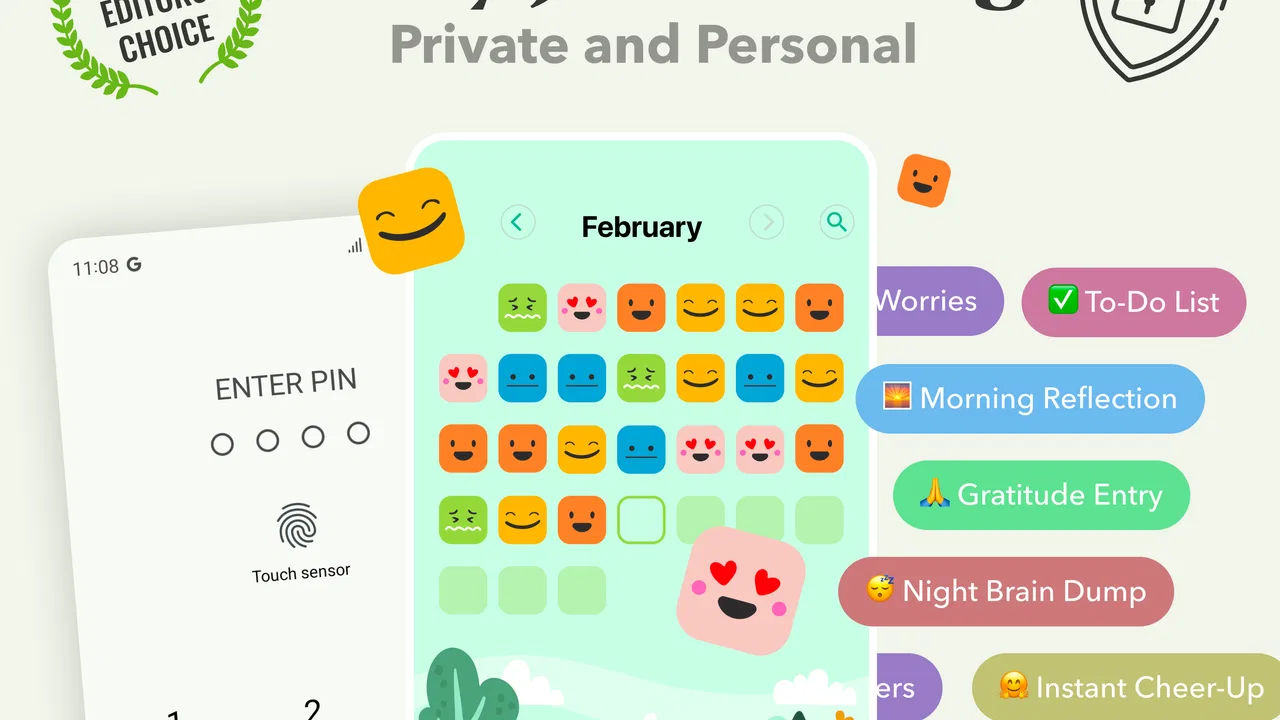
Daylio Journal prioritizes user privacy by offering local data storage, meaning your data stays on your device. For added security, users can enable a PIN lock. In addition, the app supports data backup to Google Drive or iCloud, ensuring users can recover their information if needed.
04Can I customize the mood and activity options in Daylio Journal?
Yes, Daylio Journal allows users to customize their mood and activity options. Users can create personalized icons and categories to better reflect their daily experiences. This flexibility enables a more tailored tracking experience, making the app more relevant to individual lifestyles.
05What kind of insights can I gain from using Daylio Journal?
By consistently logging moods and activities, Daylio Journal provides users with insightful statistics and trends over time. Users can identify patterns in their emotional well-being, recognize triggers, and make informed decisions to improve mental health. The app's analytics can be a valuable tool for personal development.
Pros
- User-friendly interface for easy navigation.
- Customizable mood and activity tracking.
- Data visualization through insightful graphs.
- No constant internet connection required.
- Encourages consistent self-reflection.
Cons
- Limited features in the free version.
- Some users find notifications excessive.
- No direct integration with other apps.
- Customization options can be overwhelming.
- Premium features can be pricey.

Daylio Journal - Mood Tracker
Gallery